
Children’s National forms a five-year partnership to use Chiefly. Find out why.
Children’s National released its 2026-27 block schedule on February 18, three months earlier than the year before, with one chief instead of four. The first draft took under an hour; tinkering took a week instead of five to seven weeks in Excel. Then, for the first time in Children’s National history, residents could seamlessly swap their blocks in Chiefly’s Swap Portal. Each swap is checked against the rules and can be reviewed and approved by a chief in seconds.
Children’s National has begun a five-year partnership with Chiefly because of what its first year delivered. The 2026-27 block schedule went out on February 18, three months earlier than the year before, with a first draft in under an hour, one chief instead of four, and a week of tinkering instead of five to seven weeks in Excel. Residents then got a month in the Swap Portal, where every trade was checked against ACGME and staffing rules, agreed by every resident it affected and signed off by a chief, with no emailing back and forth. The chief who ran it explains why that control can’t be outsourced, and what the saved time bought.
At a glance

All quotes in this story are from Alexandra Martinson, MD, Chief Resident 2025-26 at Children’s National, who ran the program’s scheduling that year. After using Chiefly, she joined us as an advisor in February 2026 (announcement). We love working with Alex, and she has played a pivotal role in representing exactly what chiefs want from a scheduling tool.
- Program
- Pediatric Residency Program, Children’s National Hospital, Washington, DC
- Size
- 123 residents and four chief residents
- Before Chiefly
- Four chiefs, 5 to 7 weeks in Excel, a three-layer review, release in mid-May
- With Chiefly
- One chief, a first draft in under an hour, a week of tinkering, release February 18
- Swap Portal
- A one-month window to trade blocks: rules-checked, agreed by every affected resident, signed off by a chief in about 15 seconds
What did building the block schedule take before?
Children’s National runs one of the larger pediatric residencies in the country, with 123 residents across three years and several tracks. Its block schedule was built the way most programs build theirs: by the chiefs, in Excel, from last year’s template.
“Sum total, between us four chiefs, we spent about five to seven weeks scheduling. This bled into the time where we were post admin and back on routine rotation, so there would be delays because some of us were on inpatient, some of us were on outpatient.”
Then came three layers of review: the outgoing chiefs proofread for rules the new chiefs didn’t know yet, the program director sent back new rotation cadences, and the rotation directors caught staffing errors everyone else had missed. Each round was harder than the last, because residents whose schedules already worked couldn’t be moved.
“A few times we propagated big staffing errors and had to pray that we had the old versions saved, so we could go ten steps back and fix the mistakes we made.”
The 2025-26 schedule went out on May 19, 2025. The two years before, the preliminary schedule landed on May 21 and May 17. For a resident, that is only six weeks’ notice of where the next year goes, which is not ideal.
The process with Chiefly
For 2026-27, the chiefs set three goals with Chiefly. Here is how each one was met.
Release the schedule months earlier. The year before, the preliminary schedule came out on May 15. This time:
“I’ll get to the punch line. The preliminary schedule release was February 18, which was three months earlier.”
The final schedule followed on March 26 for rising second- and third-years and April 16 for the matched interns.
Far fewer people on the build. One chief built the schedule instead of four. She took in resident requests, Chiefly turned them into a preliminary schedule that satisfied the program’s rules in under an hour, and her job became tinkering, which is where Chiefly shines as much as it does on the first build.
“Tinkering from an already built template is way easier than trying to build something from scratch.”
After her week of tinkering, the draft went to the other chiefs and the program director, then to the rotation directors a week later. That is how Chiefly builds the schedule in every program (how it works).
More flexibility and control for residents. Residents’ requests shaped the first draft. Then, with the schedule out in February, they had a month to trade blocks with each other in the Swap Portal, each trade checked against the rules and approved by a chief in seconds.
How does Chiefly handle tinkering, and how easy is it to learn?
Dr. Martinson made two points about running the schedule herself in Chiefly.
1. Chiefs need to tinker, and Chiefly nails it
The first build is only the start. Changes come up several times a week: a weekend switch, a career switch, a family switch. A chief needs to try each one, see what it does to the rest of the schedule and answer the resident quickly. Chiefly is as strong at that as it is at the build.
“I would not want to outsource scheduling completely. Once you’re in the chief role long enough … there’s experiential knowledge. You need to be able to tinker, and you have certain ideas about what should happen with the schedule.”
“I can’t send out an email, outsource a schedule change, and then wait for a response, review it, and iterate multiple times over email. … I appreciate the fact that I can use the tool to optimize my own workflow and the difficult questions, to get responses almost instantaneously and visualize the schedule myself.”
“When I’m taking a resident out of a rotation last minute, what are my options to move other residents around? That thought process could have taken a week plus before, and that week was taken from other work: building didactics, meetings with leadership. Now that question became fifteen to thirty minutes of iteration.”
That’s why Chiefly is both a service and software: our team sets up your rules and answers your questions, and you make the schedule changes yourself (why you need both).
2. Chiefly is easy to learn, and it helps others learn scheduling faster
New software usually means more work to learn. At Children’s National, Chiefly had the opposite effect. Colleagues picked it up quickly and read the schedule faster than they had in Excel, because they could see the schedule and their options at once instead of counting cells.
“The interface was easy to look at. It was not complicated.”
“Then [others in my program] start using Chiefly, and I could see them processing the schedule so much faster. … Chiefly helps visualize the schedule so much better.”
What does the software catch at 11 p.m.?
Chiefs schedule in the gaps: after clinic, late at night, between other work. That is when a tired brain approves a change that breaks staffing three blocks later.
“Very often when I was working on scheduling, it would be late at night, when my brain was not at full capacity. [With Chiefly,] I would make a tiny switch and get an error, and it was very clear and in my face exactly what the staffing issue was. Way more times than I could have counted, I would have propagated this, and it would have caused me hours more of work to fix it.”
“With Chiefly, I was confident that I was erasing the extra hours of unneeded work that I knew were inevitable, because we’re human and we make mistakes.”
The Swap Portal: residents swap, chiefs sign off, everything automated
At most programs, a released schedule is final except for parental leave and emergencies, and a swap means finding a partner, emailing the chiefs and waiting. Children’s National did the opposite: because the schedule was out three months early, residents got a one-month window to trade blocks in the Swap Portal before it was final. Residents there had never been able to trade their own blocks before.
A resident asks for a change, say cardiology instead of the ICU in block two. Chiefly checks it against the program’s rules and ACGME requirements, gets an OK from every resident it affects, then sends it to a chief to sign off. No one sends an email.
“There is no chief involved in the review. There is no PD involved in the review. [Chiefly] makes sure that people are satisfying their rotation requirements, staffing and ACGME requirements, and then approves it. All the chief does, once the residents have agreed, is glance over it. Initially that took thirty seconds of brainpower. Afterwards, fifteen or less.”
About 85% of residents who could swap took part, chiefs approved 107 swaps, nearly half of all requests were settled among residents before a chief saw them, and the whole month took an hour or less of chief time.
Case studyThe Swap Portal at Children’s National: the full numbers, with chartsWhat do residents think of Chiefly?
Requests picked up through the month as residents realized what they could move: vacation to the week that actually works, the heaviest rotations spaced out across the year, cardiology or the NICU pulled into the first quarter.
“What Chiefly offered was flexibility in terms of their work-life balance and fitting in life, but also flexibility in terms of career-building moves and when they choose to have different rotations in their training pipeline.”
“I think there was so much engagement because they didn’t get this sort of choice in residency before. Residency is a really rigid schedule. So for them to feel like they have any control over their schedule was exciting.”
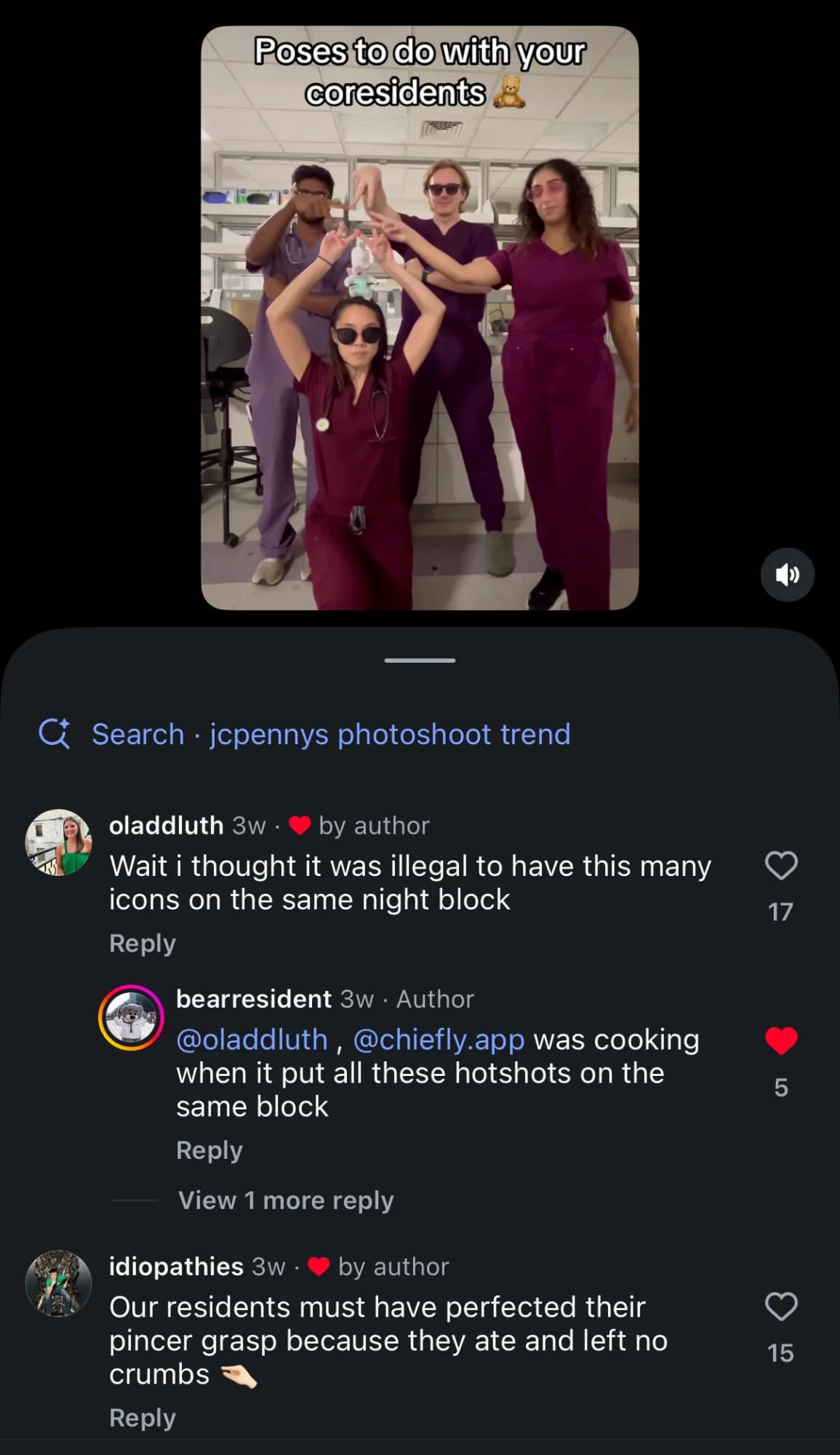
The schedule even came up on Instagram:
What did the saved time actually change?
Hours saved only matter for what they buy. At Children’s National, three things changed that had nothing to do with the schedule itself.
Residents chose their training. Swaps weren’t only about vacation. Residents moved cardiology or the NICU into the first quarter of the year, and some stacked two or three subspecialties early, to decide what to apply to. The numbers are in the Swap Portal case study.
“There were clearly people using [the Swap Portal] for their career development. They were putting cardiology earlier in the year, NICU earlier in the year, to see if that’s where they want to move their career trajectory.”
Chiefs reinvested their time in other areas. With one chief on scheduling, the other three took on work that had never fit before: a new didactics calendar with resident wellness time, an X+Y+Z schedule that protects call, new ICU staffing, and a patient-safety initiative on which team owns a patient between the emergency department and the floor.
The next chiefs started a step ahead. With the block schedule released in February, the incoming chiefs could begin on the daily and rotation schedules at once, and residents got those earlier too.
“[The new chiefs] hit the ground running. People are getting their schedules so much earlier because of everything that got moved ahead with the block release.”
After that first year, Children’s National began a five-year partnership with Chiefly.
What was onboarding like, and how did the handoff work?
Dr. Martinson’s class was the first at Children’s National to onboard onto Chiefly. The program sent its rules in the documents it already had, and Chiefly handled the rest.
The rules outlived the chiefs who set them, which is the part most programs lose every June.
“Our rules were coded in, so we knew exactly what they were and handed them off to the next chiefs. That made their onboarding much clearer, because it wasn’t us explaining something and them having to memorize it or look through a really long Google Doc. They had all the concrete numbers right in front of them.”
Each new chief class is trained, and the rules, residents and settings roll over to the next year (what happens when chiefs graduate).
Results with Children’s National
Frequently asked questions
Both, which is how Chiefly works: Chiefly’s team loads the rules and is there for questions, and chiefs run every change themselves. Changes come up several times a week, from swaps to leave to career moves, and if each one goes to a vendor by email, residents wait days for answers. At Children’s National, running changes in Chiefly turned a week of deliberation into 15 to 30 minutes.
Yes, with Chiefly’s Swap Portal. A resident requests a change, Chiefly checks it against the program’s rules and ACGME requirements, every resident it affects approves it, and a chief gives the final sign-off. At Children’s National that sign-off took about 15 seconds per swap, with no emailing back and forth.
With Chiefly, months earlier. Children’s National released its 2026-27 preliminary schedule on February 18, with finals on March 26 and April 16, against mid-May releases the three years before. Once Chiefly has the rules, a first draft takes under an hour and the chief’s tinkering about a week, so the limit is the program’s own review calendar, not the build.
A block swap is two residents trading rotation blocks after the block schedule is released, for example one taking cardiology in block two and the other taking the ICU. Chiefly’s Swap Portal automates the request, the matching and the rules check, leaving the chief a quick final sign-off. Without it, a resident finds a partner and the chiefs check and approve the trade by hand.
With Chiefly, the rules stay in the tool. At Children’s National they were set once, with the ACGME requirement and the program’s own requirement side by side, and the next chiefs inherited the concrete numbers along with training on Chiefly. Chiefly works like TurboTax: rules, residents and settings roll over each year, so new chiefs start from last year’s setup instead of a blank grid. In most programs the rules live in the outgoing chiefs’ heads and a long document, so each class relearns them.
Sources
Keep reading
All posts
Boston Children’s signs a multi-year deal with Chiefly after automating its block schedule
How a 188-resident program across two hospitals built a fully ACGME-compliant block schedule in a week.
Read the case study
UTHealth Houston’s general surgery residency renews with Chiefly. Its program director explains why.
Chiefly’s first surgical program: a revised schedule back in an hour instead of hours in Excel, no understaffing surprises this year, and a scheduling advisor whenever they wanted one.
Read the case studyChildren’s National pilots Chiefly’s Swap Portal: never-before flexibility for residents, 85% took part, ~350x less admin time
Residents had never been allowed to trade their own blocks. In one month in the Swap Portal, 85% of those who could took part, 67 shaped their own schedules, and the chiefs spent an hour or less reviewing all of it.
Read the case study
Chiefly helps Augusta University’s family medicine residency navigate a 30% complement increase
Two people, 49 residents, a 30% jump in headcount, and not one re-run request to Chiefly. How Augusta’s family medicine residency runs its own rotation calendar.
Read the case study
From overwhelmed to empowered: how UVA Pediatrics chiefs reclaimed 3 months of time
From a spreadsheet that ate hundreds of chief hours to a block schedule built in a week and a half.
Read the case studyWelcoming Alexandra Martinson, MD
Welcoming Alexandra Martinson, MD: a chief resident who speaks code
A 2025-26 Children’s National chief resident with a computer science degree and research in AI for medicine.
Read the announcement

Welcoming our new advisors

Announcing our new advisors, with tangible impacts for chiefs, PDs, and DIOs
Boston Children’s Innovation & Digital Health Accelerator, plus advisors in fairness, compliance, and accreditation.
Read the announcement
Germane Solutions invests in Chiefly and uses it to help its clients
The GME consulting firm connected to 40%+ of the GME market met Chiefly while modeling UVA Health’s complement increase. Now it’s an investor and a user.
Read the announcement
QGenda alternatives for residency programs: Chiefly vs QGenda
Chiefly automates residency block, daily, clinic and call scheduling, all integrated; QGenda schedules whole health systems. Here is how they compare for residency programs.
Read the comparison
Amion alternatives for residency programs: Chiefly vs Amion
Chiefly automates the residency block, daily, clinic and call schedules; Amion is used mainly for publishing call and who’s on call. Here is how they compare.
Read the comparisonExcel vs residency scheduling software: Chiefly vs Excel
How long Excel residency schedules take, where they break, and when it’s time to move off the spreadsheet.
Read the comparisonACGME duty hour rules for residents (2026): 80 hours, 24+4 and the proposed changes
Every ACGME duty hour rule a residency schedule has to respect, with the 2026 section numbers, how averaging works, and what the proposed changes would mean.
Read the guideResidency block schedule software: build the rotation schedule from your rules
Chiefly builds your residency block and rotation schedule from your program’s rules, rolls it over each year, and keeps it compliant as the year changes.
Read the guideHow chief residents make the block schedule, step by step
A step-by-step guide to building a residency block schedule: what to gather, the order to build in, the rules to check, and how to publish it.
Read the guideResidency scheduling service or software: why not both?
Chiefs shouldn’t have to build the schedule by hand, but they should keep control of it. Why the answer is software and a service, and how the four ways to make a residency schedule compare.
Read the guideMaternity and parental leave in residency: ACGME rules and who covers the schedule
What the ACGME requires for medical, parental and caregiver leave, how leave affects duty hours and training time, and how programs cover the schedule.
Read the guideBest residency scheduling software: how to choose in 2026
In most programs the year is still planned and built in Excel, and the scheduling tools mostly publish it. How to choose software for the half of the job that takes the time.
Read the guideWhat is an X+Y schedule in residency? 4+1 and 6+2 explained
How X+Y schedules such as 4+1 and 6+2 separate inpatient and clinic time, why programs adopt them, and how to build one.
Read the guideCan ChatGPT build a residency schedule?
What happens when chiefs use ChatGPT or Claude to build resident schedules, where they break, and what to use instead.
Read the guide