
From overwhelmed to empowered: how UVA Pediatrics chiefs reclaimed 3 months of time
The UVA Pediatrics Residency Program faced shifting ACGME requirements and a spreadsheet-based system that consumed hundreds of chief resident hours. Chiefly streamlined block scheduling in just 1.5 weeks, with real-time visibility into compliance, staffing, and resident preferences.

“The extra time will allow chiefs to participate in more clinical activities which essentially will pay for Chiefly and then some.”
 Lisa Hainstock, Program Director


Executive Summary
The University of Virginia's Pediatrics Residency Program, home to 40 residents operating on a 13-week block schedule, was facing growing scheduling complexity. Shifting ACGME requirements, frequent mid-year changes, and a manual, spreadsheet-based system left the chief residents overwhelmed and spending hundreds of hours on administrative tasks.
To address this, UVA partnered with Chiefly. Within weeks, Chiefly was onboarded and streamlined the entire block scheduling process, saving time, reducing errors, and giving the program real-time visibility into ACGME compliance, staffing, and resident preferences.
Background
We went back to interview three years of chief residents, and the stories were consistent: scheduling dominated their time, fragmented their workflow, and limited quality time with residents and patients.
Each class developed their own workaround system, all relying on heavy manual effort. Here's what they had to say:
Chiefs from 2020-2021 & 2021-2022:
- "I did pen and paper as a double-check on the schedule."
Chiefs didn't trust their spreadsheet-based system and had to manually verify every assignment. - "I wish I had time to teach more... to be more present on rounds, or do attending time and professional development."
The scheduling workload directly limited their ability to lead and grow in their roles.
Chiefs from 2022-2023:
- "Scheduling definitely interfered with your other responsibilities as a chief."
- "A large part of Chief year is having face time with the residents to be a resource for them if they need anything. This was hard because I felt like we very often had to be behind closed doors doing ‘secret' scheduling and such for specific residents as requested."
- "I would spend 8-10 hours a day on scheduling [during intensive scheduling periods]...It was all I did at work, and after hours too."
Block scheduling was particularly challenging. - "There were errors!"
Chiefs relied on residents to spot their own scheduling errors after publication.
On the surface, manual scheduling seems like just another administrative task. But what we found is that the consequences ran deeper than time lost in spreadsheets. Inefficient scheduling created ripple effects across the entire residency experience, impacting education, wellness, clinical care, and costing the hospital money.
Hidden Costs of Manual Scheduling:
Here are just a view tangible examples that the program highlighted:
- Financial Cost to the hospital: Chiefs, APDs, Coordinators, and PDs all spend hours scheduling that could otherwise be used for clinical work or avoiding costly moonlighting/PRN coverage.
- Compliance Risk: Manual tracking of duty hours and days off risks non-compliance with ACGME requirements, with no audit trail.
- Educational Impact: Less time for teaching, mentoring, or attending rounds results in fewer learning opportunities.
"I personally wish I had more time to join rounds... I wasn't able to join more than once or twice a week."
Kelsey Berry (Chief Resident 2023-2024) - Resident Burnout and Mistrust: When fairness was unclear and errors slipped through, morale declined. Residents had to double-check their own schedules.
- Downstream Clinical Impact: Schedule errors rippled into advanced practice provider assignments and clinic workflows.
"One time last year, someone didn't show up for their shift."
Lauren Ferguson (Chief Resident 2024-2025) - Loss of Institutional Knowledge: Chiefs each created their own patchwork system that was difficult to hand off to successors.
- Reduced interest in the Chief role: UVA struggled to recruit Chiefs due to the intense administrative burden. Chiefly has significantly helped reduce that load.
Solution
Before Chiefly, UVA Pediatrics chiefs described the block build process as a 2-3 month workload, dealing with the time-consuming “domino effect” of from making moves to the block schedule, manually naviating changes to ACGME, and balancing resident preferences.
After a 2-day onboarding process, the chiefs built an entire academic year's block schedule in just 1.5 weeks. Chiefly not only pre-loaded the tool to meet the unique program requirements, but they handed the chiefs a tool they could use year-round to efficiently make changes as they come up throughout the year.
Here's How Chiefly Reclaimed Time:
- Automation that just works: Chiefly's algorithm accounted for vacation requests, ACGME rules, staffing, and custom inputs, producing a draft schedule in seconds.
- Rapid Experimentation: Chiefly introduced a dynamic workspace where chiefs could scenario-test changes to staffing, ACGME requirements, or resident preferences in real time. UVA used this feature to automatically test and justify a complement increase, which was approved by the hospital.
"[Chiefly] is a super helpful tool for any program, but especially one with tight staffing margins, or a program trying something new… I don't think we would have been able to make as compelling of an argument for the residency complement increase as we did since we could quickly make full dummy schedules to substantiate our claims of what would be viable and what wouldn't be."
Lauren Ferguson (Chief Resident 2024-2025) - Designed for easy adoption: Chiefly's interface was designed with chiefs in mind: clear visualizations, the ability to quickly preview, adjust, and finalize schedules. All of these additions without the need for a huge up-front lift to learn the tool.
"We were delayed getting started with the schedule due to shifting schedules of our off-service resident rotators and programmatic changes with the curriculum. It would not have been possible to create the schedule by our deadline without Chiefly doing the heavy lifting for us, and without the tool's flexibility to account for all those shifting components."
Lauren Ferguson (Chief Resident 2024-2025)
Results
427% reduction in manual scheduling time
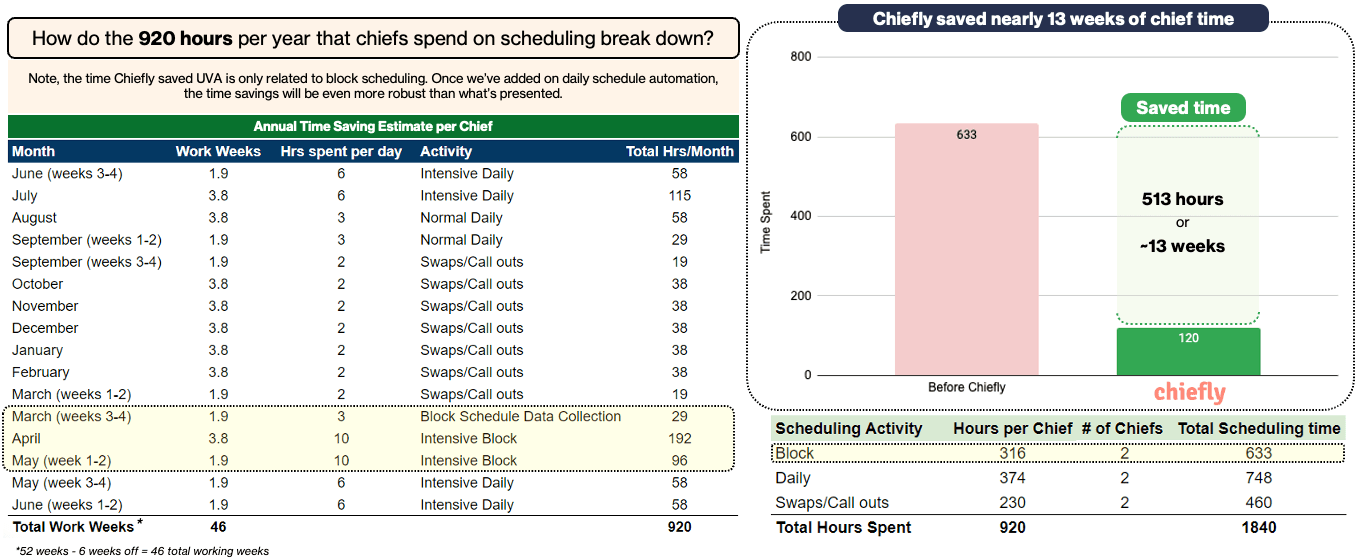
By reducing scheduling from 633 collective hours to 120 hours, UVA saved 513 hours of administrative time. If even 50% of those hours were reallocated to seeing patients (at $105/hr), that equates to ~27k in additional revenue for the department, just during the block‑building period.
50% more attending time for each Chief Resident
"The extra time will allow chiefs to participate in more clinical activities which essentially will pay for Chiefly and then some."
Lisa Hainstock (Program Director)
"My co-chief and I were able to do our attending time during the block schedule period, which wouldn't have been possible without the time from Chiefly, we just wouldn't have gotten to do it."
Lauren Ferguson (Chief Resident)
100% ACGME compliance
Chiefly gave peace of mind that the program was in compliance with staffing and ACGME requirements (based on the program's interpretation of ACGME requirements).
Enhanced Schedule Fairness
"I was able to accommodate everybody's vacation and elective wishes in a year that we have had the least available residents and the most scheduling constraints ever. It would have been too tall of an order for a couple humans and an Excel sheet."
Lauren Ferguson (Chief Resident)
Improved Schedule Transparency
"Prior [to Chiefly,] there was a lot of distrust of how the schedule was made and why certain decisions were made. With Chiefly we are able to look at graduation requirements and create visuals for the residents to understand the rotations required of them."
Mae Furr (Chief Resident)
Chief Professional Development Opportunities
"I took on other projects like my research and the complement increase Taskforce."
Lauren Ferguson (Chief Resident)
"I was able to attend and schedule meetings that I was unable to prior. I completed certifications and joined task forces to help move forward my career after Chief year."
Mae Furr (Chief Resident)
Keep reading
All posts
Boston Children’s signs a multi-year deal with Chiefly after automating its block schedule
How a 188-resident program across two hospitals built a fully ACGME-compliant block schedule in a week.
Read the case studyChildren’s National forms a five-year partnership to use Chiefly. Find out why.
One chief built the 2026-27 block schedule three months early, then residents traded blocks in the Swap Portal with no emailing back and forth. The chief who ran it on why Children’s National is staying for five years.
Read the case study
UTHealth Houston’s general surgery residency renews with Chiefly. Its program director explains why.
Chiefly’s first surgical program: a revised schedule back in an hour instead of hours in Excel, no understaffing surprises this year, and a scheduling advisor whenever they wanted one.
Read the case studyChildren’s National pilots Chiefly’s Swap Portal: never-before flexibility for residents, 85% took part, ~350x less admin time
Residents had never been allowed to trade their own blocks. In one month in the Swap Portal, 85% of those who could took part, 67 shaped their own schedules, and the chiefs spent an hour or less reviewing all of it.
Read the case study
Chiefly helps Augusta University’s family medicine residency navigate a 30% complement increase
Two people, 49 residents, a 30% jump in headcount, and not one re-run request to Chiefly. How Augusta’s family medicine residency runs its own rotation calendar.
Read the case study
Welcoming Alexandra Martinson, MD
Welcoming Alexandra Martinson, MD: a chief resident who speaks code
A 2025-26 Children’s National chief resident with a computer science degree and research in AI for medicine.
Read the announcement

Welcoming our new advisors

Announcing our new advisors, with tangible impacts for chiefs, PDs, and DIOs
Boston Children’s Innovation & Digital Health Accelerator, plus advisors in fairness, compliance, and accreditation.
Read the announcement
Germane Solutions invests in Chiefly and uses it to help its clients
The GME consulting firm connected to 40%+ of the GME market met Chiefly while modeling UVA Health’s complement increase. Now it’s an investor and a user.
Read the announcement
QGenda alternatives for residency programs: Chiefly vs QGenda
Chiefly automates residency block, daily, clinic and call scheduling, all integrated; QGenda schedules whole health systems. Here is how they compare for residency programs.
Read the comparison
Amion alternatives for residency programs: Chiefly vs Amion
Chiefly automates the residency block, daily, clinic and call schedules; Amion is used mainly for publishing call and who’s on call. Here is how they compare.
Read the comparisonExcel vs residency scheduling software: Chiefly vs Excel
How long Excel residency schedules take, where they break, and when it’s time to move off the spreadsheet.
Read the comparisonACGME duty hour rules for residents (2026): 80 hours, 24+4 and the proposed changes
Every ACGME duty hour rule a residency schedule has to respect, with the 2026 section numbers, how averaging works, and what the proposed changes would mean.
Read the guideResidency block schedule software: build the rotation schedule from your rules
Chiefly builds your residency block and rotation schedule from your program’s rules, rolls it over each year, and keeps it compliant as the year changes.
Read the guideHow chief residents make the block schedule, step by step
A step-by-step guide to building a residency block schedule: what to gather, the order to build in, the rules to check, and how to publish it.
Read the guideResidency scheduling service or software: why not both?
Chiefs shouldn’t have to build the schedule by hand, but they should keep control of it. Why the answer is software and a service, and how the four ways to make a residency schedule compare.
Read the guideMaternity and parental leave in residency: ACGME rules and who covers the schedule
What the ACGME requires for medical, parental and caregiver leave, how leave affects duty hours and training time, and how programs cover the schedule.
Read the guideBest residency scheduling software: how to choose in 2026
In most programs the year is still planned and built in Excel, and the scheduling tools mostly publish it. How to choose software for the half of the job that takes the time.
Read the guideWhat is an X+Y schedule in residency? 4+1 and 6+2 explained
How X+Y schedules such as 4+1 and 6+2 separate inpatient and clinic time, why programs adopt them, and how to build one.
Read the guideCan ChatGPT build a residency schedule?
What happens when chiefs use ChatGPT or Claude to build resident schedules, where they break, and what to use instead.
Read the guide